


Spaceship Earth
An educational series explaining the operation of the solar system using 3D animation. Its 52 episodes provide a week-by-week description of the operation of the solar system.
What critics are saying
Verdicts use the same scale as your list: highly recommended through avoid — plus optional scores and blurbs.
Nobody on Critic, Sir! has logged a verdict for this title yet. The silence is either respectful or suspicious.
Sign in and use Add to My List below to share your own verdict.
Cast

Seasons
Spaceship Earth Season 1 (Winter)

1.Week 1: The Journey Begins (New Year)
18-05-19975 minWhy it is cold when the Earth is closest to the sun. Why we see Venus in the morning. The planets are close, the stars unreachable.

2.Week 2: Travelling in the Solar System (Early January)
18-05-19975 minDay and Night. A gigantic Sun with tiny planets. A look at the Zodiac. The solar system is the present; the stars are the past.

3.Week 3: The Moon, Our Companion (Mid-January)
18-05-19975 minThe Sun is on time but the Moon is late. Why we see the Moon as a crescent. The half-moon crosses the Earth's orbit. Where the Moon came from. The Moon: Delay in space and Time.

4.Week 4: The Full Moon (Late January)
18-05-19975 minDiscovering Mercury. Distant moons of other planets. Why we always see the same side of the Moon. Why we see the Sun so low but the Moon so high.

5.Week 5: Earth's Rotation (January/February)
18-05-19975 minEarth's Rotation. The Moon shows us where Mars is. Copernicus: The Earth in orbit. Why the Earth turns. Crossing time zones.
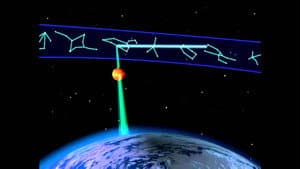
6.Week 6: Copernicus and Kepler (Early February)
18-05-19975 minHidden planets. Kepler discovers the planets' timetable. The Earth moves more quickly in Winter. Earth overtakes Mars. Why we have two tides every day.

7.Week 7: Gravity (Early/Mid-February)
18-05-19975 minWhy the Earth is round. Newton's apple. Why the Earth does not fall into the Sun. Three minutes more Sun every day. Sundials and the Earth's axis. Comets.

8.Week 8: The Stars (Mid-February)
18-05-19975 minColumbus and the Pole Star. Earth wobbles over the centuries. The imaginary 'heavenly vault'. The Sun, our star. Infinitely large to infinitely small.

9.Week 9: The Calendar (Late February)
18-05-19975 minLeap Days: The Earth misses a quarter of a day. Gregorian and Orthodox calendars. Solar and lunar calendars. Solid and gaseous planets.

10.Week 10: Waning Moon and Solar Eclipses (Early March)
18-05-19975 minThe half-moon shows where we are going. Where the stars go during the day. The Moon and the planets: The Sun's invisible companions. The Moon's shadow on the Earth: Solar Eclipses.

11.Week 11: Eclipses and Occultations (Mid-March)
18-05-19975 minAnnular solar eclipses. Partial solar eclipses. The Moon eclipsed in Earth's shadow. Occultation of Aldebaran.
Watching Lists
to create and edit public lists.
Loading lists…
Purchase & Discovery
Find this title on Amazon
Digital
Prime Video & digitalAmazon mixes rent, buy, and Prime in one place — one search covers the usual options.
Physical edition
4K Blu-ray & physical releasesSearch on AmazonOfficial merchandise
Official-style merch searchApparel, collectibles, and moreAs an Amazon Associate, Critic, Sir! earns from qualifying purchases. Full disclosure