
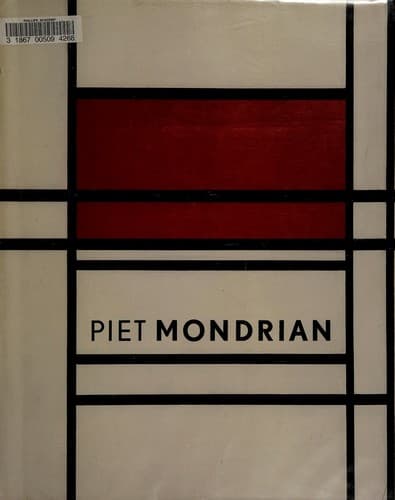
Piet Mondrian, 1872-1944
Although Mondrian is generally recognized for his powerful influence on twentieth-century art, architecture and design, his achievement as a painter has been underestimated. This comprehensive monograph traces Mondrian's career, from his early Dutch landscapes at the turn of the century to the dazzlingly rhythmic compositions he painted in New York at the end of his life. In this volume, his identity as a modern artist is addressed in detail. While the continuity within his entire evolution is fully explored, particular attention is paid to moments of dramatic change: his discovery of modernism and later of cubism; his struggle toward abstraction; his invention of the "neoplastic" style for which he is best known; and his dynamic development of that style from the 1930s until the end of his career. An emphasis on Mondrian's pictorial development also involves an emphasis on his working process. While this volume stresses the modernity of Mondrian's work, it demonstrates, especially in its presentation of his unfinished works, that Mondrian's abstract art was far from mathematical, either in its origins or in its expression; rather, it was the product of a highly intuitive mind and hand, gradually working toward carefully modulated but far from measurable compositional solutions. In the present volume, the texture and autograph surface of each work are taken into account, and Mondrian's original framing decisions have been recorded and reproduced, often for the first time. Yve-Alain Bois's major essay on the artist's career focuses especially on the invention and development of Mondrian's neoplastic style. In examining the parallel evolution of the artist's theory and his art, Bois supports the painter's own rejection of any interpretation of his abstract work as either geometric or symbolic, and demonstrates that far from constituting a formal exercise, neoplasticism offered an entirely new articulation of painting and thought. Bois pays particular attention to the late work and to the ways in which the artist conceived it as a critique of his earlier achievements. Hans Janssen explores the relationship between theory and practice in Mondrian's neoplasticism. From the early landscapes and throughout the mature career, he sees a fundamental continuity in the role of the symbolic. The fully illustrated Chronology of the artist's life and work and the Catalogue by Joop Joosten and Angelica Z. Rudenstine contain much new documentation, as well as extensive and largely unpublished quotations from Mondrian's correspondence with his contemporaries.
Sign in to add this book to your list.
What critics are saying
Verdicts use the same scale as your list: highly recommended through avoid — plus optional scores and blurbs.
Nobody on Critic, Sir! has logged a verdict for this title yet. The silence is either respectful or suspicious.
Sign in and use Add to My List below to share your own verdict.
Reading Lists
Sign in to create and edit public lists.
Loading lists…
Purchase & Discovery
Find this title on Amazon
Physical edition
All Books (physical editions)Search on AmazonOfficial merchandise
Official-style merch searchApparel, collectibles, and moreAs an Amazon Associate, Critic, Sir! earns from qualifying purchases. Full disclosure